
Body weight and body composition are two different measurements, and the gap between them explains one of the most discouraging moments in training: the scale that refuses to move even though your clothes fit better. Weight is one number with everything lumped in: muscle, fat, water, bone. Body composition splits that number into its parts. When you strength train, muscle can increase while body fat decreases, and because those changes offset on a scale, your weight can hold flat for weeks while your body genuinely changes. That flat stretch is not failure. Quite often, it is the plan working exactly as designed.
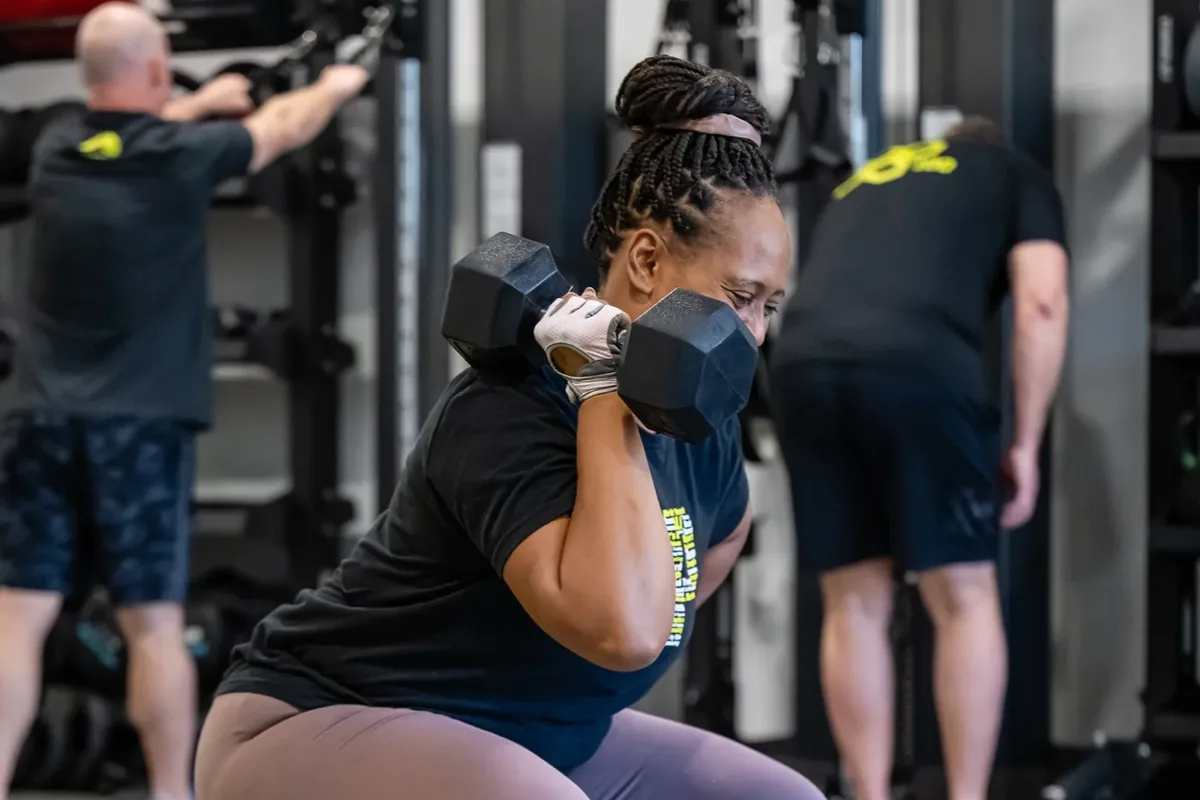
How can two people at the same weight be in completely different shape?
Because the scale weighs everything at once. Picture two adults of the same height, both 180 pounds. One carries a decade of consistent strength training; the other has not trained in years. Same number on the scale, completely different bodies: different amounts of muscle, different body fat percentages, different strength, different Tuesday. Weight told you what they have in common. Composition is everything the number left out.
That is all "body composition" means. It is not a different measurement of the same thing; it is an answer to a different question. The scale asks how much. Composition asks of what.
What is body recomposition?
Recomposition is what happens when the two component lines move in opposite directions at once: muscle up, body fat down. It is common in adults returning to strength training after time away, which describes most people who walk into our studio in the Ahwatukee Foothills. The math has a frustrating property: a few pounds of new muscle and a few fewer pounds of fat can net out to almost nothing. The body changed twice over; the scale reports a rounding error.
Timelines deserve honesty here. Most members notice improvements in energy, strength, and confidence within the first few weeks, while body-composition change typically shows over 8 to 12 weeks. The early weeks of a recomposition are exactly when the scale is at its least informative.
Why do untracked people quit right when it is working?
Follow the experience of someone tracking only weight. They train consistently for six weeks. Their clothes fit differently, stairs feel shorter, the dumbbells they started with feel light. Then the morning weigh-in delivers its verdict: same number. With no other data, "nothing is happening" is a perfectly logical conclusion, and it lands at the precise moment the deeper change is underway. That is where untracked people quit. Not because the plan failed, but because their only instrument could not see it succeeding.
This is a measurement problem, and measurement problems have measurement solutions.
Key Takeaway
The scale reports one number with muscle, fat, and water lumped together, so it can read as no change during weeks when muscle is rising and body fat is falling. That flat stretch is where people without composition data give up. Track composition, not just weight, and the same flat scale becomes visible progress.

How do you see which kind of change is happening?
Measure the components. At Alloy Personal Training Ahwatukee Foothills, every member gets a monthly InBody body composition scan, reviewed with their coach. The scan separates skeletal muscle mass from body fat, which turns the flat-scale month into a readable one: muscle up a pound, fat down a pound, weight unchanged, plan working. Because we measure it monthly, the question "is anything happening?" gets a data answer instead of a mood answer. If you want to know what each line on the result sheet means, we have a full walkthrough in your InBody scan explained.
What are the corroborating signals?
Composition data is the primary instrument, but recomposition leaves fingerprints everywhere else, and they are worth noticing:
- Clothes. Waistbands and shirt shoulders respond to shape, not weight. Scale flat, jeans looser is a composition story told in denim.
- Benchmarks. Working weights climbing month over month means muscle is being built and kept.
- Capability. The yard work that stopped requiring a recovery day, the flight of stairs that stopped being an event, the suitcase that goes overhead without strategy.
When those signals agree with the scan, you can safely stop arguing with the bathroom scale. We have written before about why a monthly scan beats a daily weigh-in as a tracking habit. This is the deeper reason underneath that habit: the two tools answer different questions, and composition's question is the one your goals actually ask. None of these signals is precise on its own, which is why they corroborate rather than replace the scan. Together, though, they are hard to argue with.
Why does this matter more after 40?
Because after 40, the composition of your weight matters more than the amount of it. The goal for most adults here is not simply to be smaller. It is to be stronger, more capable, and durable for the decades ahead, and every one of those words is about muscle. A weight-loss result that quietly spent muscle to move the scale is a bad trade at any age; after 40, when muscle is already the asset that drifts without training, it is a trade you cannot afford to make blind.
Recomposition is the better deal, and it is the one coached strength training is built to deliver: keep and build the muscle, lose the fat, and measure both so you know the trade you actually made.
What if your goal was never a number?
For most adults over 40, it was not. The real goal is a stronger, leaner, more capable body for the decades ahead, and composition is the measurement that matches it, with coached strength training as the way the recomposition happens. That model, assessment-first and measured monthly, is what we run for adults over 40 in Ahwatukee. To get your own baseline, Book Your Complimentary VIP Consultation: a conversation about your health history and goals, an InBody body composition scan, a functional movement assessment, and an introductory coached workout.